When most clients first reach out to us, they think they need something simple.
A new sofa. A refresh in one room. Maybe updated window treatments.
That’s usually where the conversation starts. It’s almost never where it ends, and that’s not because we upsell. It’s because the real problem is almost always bigger than the one they walked in with. Our job is to help them see it.
Here are three of the most common mistakes we see in South Florida homes, and how we approach things differently.
Mistake #1: Designing One Room in Isolation
We recently worked with a client who came to us wanting to replace a single living room set. On the surface, completely straightforward. But when we looked at the space together, something immediately became clear: that living room was fully visible from the family room and TV area. If we updated only one of those spaces, the other would instantly feel dated – and worse, it would actually diminish the impact of the new design. The contrast would work against her, not for her.
So we had a conversation. Not a sales conversation – a real one.
We asked her to step back and look at the whole picture. What did the space need to feel like? How did she actually move through it day to day? What was she tired of looking at, and what did she want to hold onto? By the time we’d talked it through, the brief had changed entirely. We ended up designing the living room, the family room, the TV area, and the bathrooms – not all at once, but as a cohesive phased plan with a clear through-line.
She told us afterward that she hadn’t realized how much the disconnected rooms had been quietly bothering her. The individual pieces weren’t the problem. The lack of continuity was.
That’s the mistake we see most often: treating a home as a collection of separate rooms rather than a single, connected experience. When you design in isolation, new pieces feel out of place, your investment looks smaller than it is, and the home never quite comes together. The fix isn’t always doing more – it’s planning more, even when you’re only ready to act on part of it.
Mistake #2: Skipping Pre-Planning
This is the one that costs people the most money, and it’s the most avoidable.
We tell every client the same thing at the start of a project: function and safety first, then beauty. That means thinking ahead – sometimes well ahead – for things you’re not ready to install yet. Grab bars in a bathroom. Electrical placement for lighting you’ll add in a year. Structural support behind walls for window treatments. Layout decisions that affect how a room works for the next decade.
It sounds unsexy. It is, until you skip it.
Without pre-planning, you open walls twice. You redo finished surfaces. You spend money correcting decisions that could have been made right the first time for a fraction of the cost. We’ve had clients come to us after working with someone else, and the first question we’re often asked is: “Can we fix this without tearing everything out?” Sometimes yes. Sometimes no.
The good news is that pre-planning doesn’t require doing everything at once. It just requires thinking ahead. And that’s part of what we bring to every project – not just taste, but a long view.
Mistake #3: Trying to Do Everything at Once (or Nothing at All)
Design can feel overwhelming. Every client hits that wall at some point, usually somewhere between the first fabric sample and the third revision of the floor plan. The instinct is either to rush through it and make quick decisions, or to freeze entirely and do nothing.
Both are mistakes.
What we’ve found works is a phased approach with a clear roadmap. We start by identifying the highest-impact areas – the spaces where a change will be felt every single day – and we build from there. Not because you can’t afford to do it all, but because good design needs time to breathe. You need to live with one layer before adding the next. You need to see how natural light shifts across a new material, how a room feels at 7pm versus 7am, whether a piece you loved in the showroom still feels right three weeks in.
Great design isn’t an event. It’s an evolution. And the clients who end up with homes they truly love are almost always the ones who gave it the time it deserved.
What Actually Makes Our Process Different
Our process starts the same way every time: we listen. Not to what you think you want, but to what’s underneath that.
We ask what you hate about your space. We ask why you’re having this conversation now, after however many years of living with things the way they are. We ask what feels meaningful and what you’ve quietly wanted to change for years but never prioritized. Those answers – the honest, unpolished ones – are where good design actually begins.
From there, we build something layered and intentional. Our philosophy is simple: function and safety first, then beauty, then the refinement that comes from layering over time.
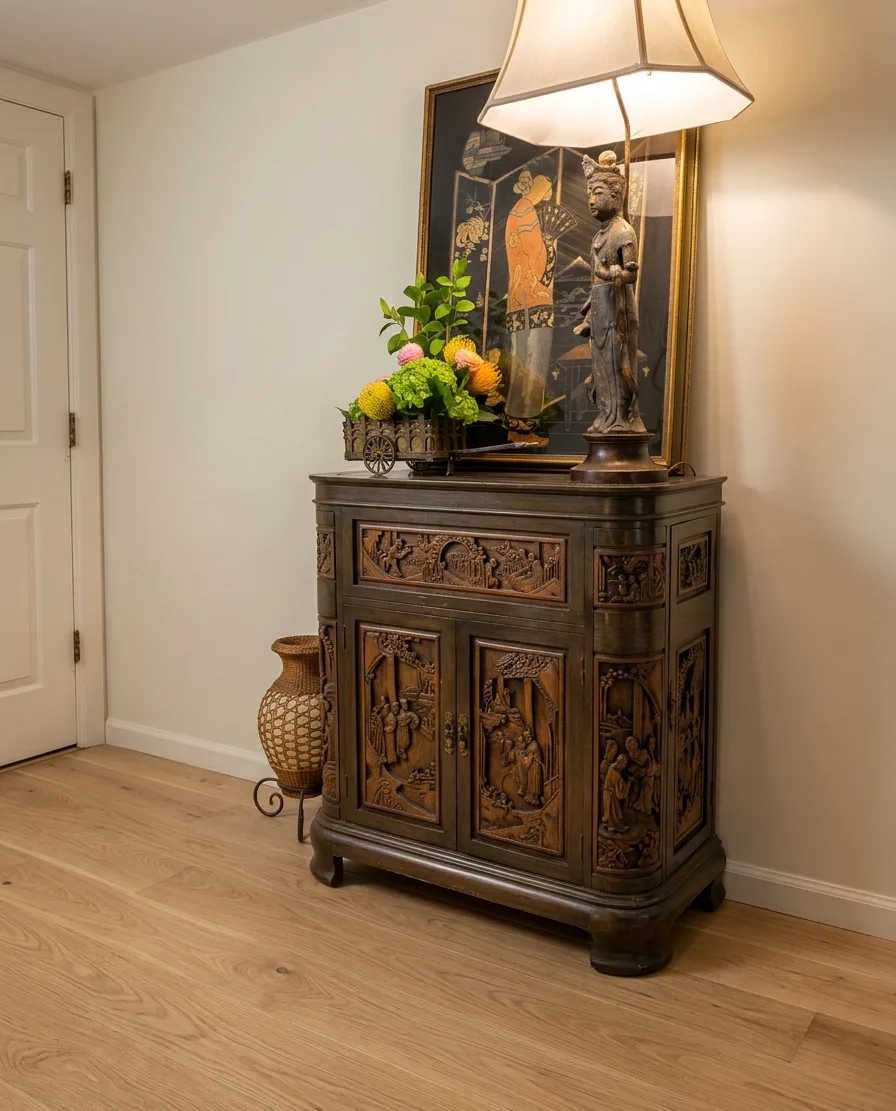
One of the things clients tell us they didn’t expect is how much we work with what they already have. We don’t believe in starting from scratch for the sake of it. Some of our favorite projects have been built around an antique a client inherited, or a piece they’ve moved from house to house for twenty years, finally given the right setting. That layering of old and new – the meaningful alongside the new – is what keeps a space from feeling staged. It’s what makes it feel like yours.
Designing for South Florida Specifically
Designing in South Florida comes with its own set of considerations that not every designer is thinking about.
The climate is the obvious one – humidity, salt air near the coast, intense UV exposure – and it affects material choices more than most clients realize. Fabrics that look beautiful in a showroom can deteriorate quickly if they’re not suited to the environment. Hardware corrodes. Certain finishes fade. Part of what we bring is knowledge of what actually holds up here, not just what photographs well.
But beyond the practical, there’s the lifestyle. South Florida homes need to work differently than homes elsewhere. Indoor-outdoor flow matters in a way it simply doesn’t in a climate where you close the windows for eight months of the year. Spaces need to feel livable and comfortable – not aspirational showrooms – because people are actually in them, year-round, in the heat, with guests, with family. The homes we love most are the ones that feel effortless to be in, not effortful to maintain.
We also work across a genuinely wide range of aesthetics here – coastal, classic, transitional, contemporary – which means we’re not imposing a signature look on every project. What ties our work together isn’t a style; it’s an approach.
Who We Work Best With
Our best clients are people who value quality over shortcuts and a timeless result over whatever’s trending. They want to invest thoughtfully – whether that’s a $5,000 refresh of a single room or a full-scale transformation – and they want a designer who will tell them the truth, even when the truth is “you don’t need to replace that, you need to reposition it.”
They’re not looking for a decorator to execute a vision they’ve already decided on. They’re looking for a partner who will ask the questions they haven’t thought to ask, see the problems they’ve been living around, and build something that holds up – visually, functionally, and emotionally – for years.
If that sounds like the kind of process you’re looking for, the first step is a conversation.
Ready to Start?
Most of our best projects started with a client who thought they just needed one thing.
If you’re thinking about updating your home – whether it’s one room or a whole-home transformation – come with your frustrations. Tell us what’s been bothering you for years. Tell us what you’ve been putting off. That’s the most useful thing you can bring to a first conversation, and it’s where we do our best work.
[Come with your frustrations] (https://rhysdylandesign.com/contact/) and let’s talk about what your space could become.
Rhys Dylan Design creates interiors that reflect how people actually live – residential and commercial spaces in South Florida, grounded in discovery, shaped by function, and layered with intention.